
This page is best viewed on desktop.

To continue on mobile, we recommend to view in landscape mode.

Explore biodiversity across Australia's national Marine Parks through the lens of environmental DNA

powered by

Start exploring

Life in our oceans is vast, diverse and difficult to monitor. Environmental DNA (eDNA) provides a new lens for exploring marine biodiversity across large spatial and temporal scales. Minderoo Foundation and Parks Australia partnered to deliver the first eDNA benchmark assessment across Australia's Marine Parks. Explore here the data, discoveries and insights captured through this initiative.

Key statistics

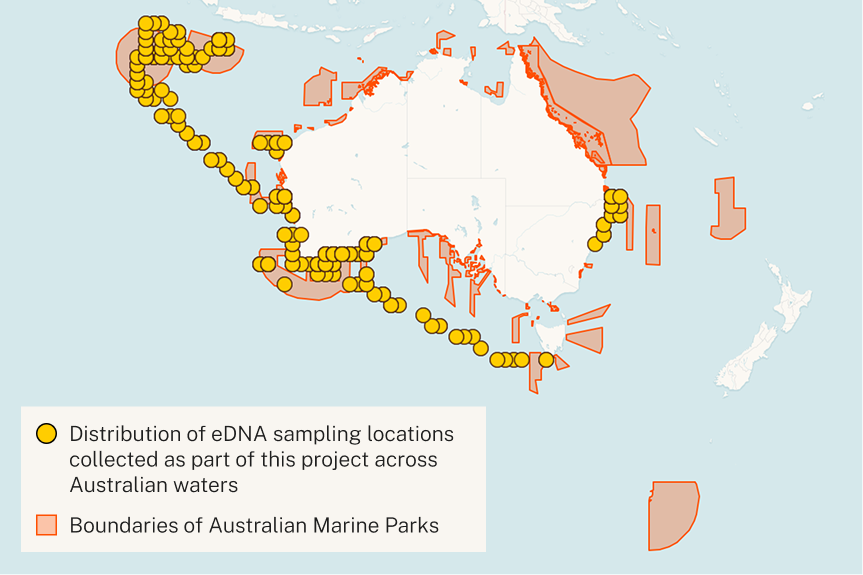
5,598 samples collected
across Australian coastal and offshore waters
13 research expeditions completed
covering 4,000 km north to south and 6,000 km east to west
3+ billion DNA barcodes
recovered from seawater samples, including 385,100 unique DNA sequences
+50% of Australia’s known marine fish diversity
represented in the dataset
2,217 marine vertebrate species
identified including 2,064 bony fishes, 94 sharks and rays, 31 mammals, 23 birds and 3 turtles
302 tree-of-life datasets produced
capturing bacterial, phytoplankton and invertebrate diversity

About the project

This project is a collaboration between Minderoo Foundation and Parks Australia to better understand marine biodiversity across Australia's ocean estate using eDNA. Nearly 6,000 eDNA samples were collected from coastal and offshore waters around Australia between 2021 and 2025. These samples span a wide range of ecosystems, from tropical reefs, temperate waters, continental shelf habitats and the deep ocean. The extensive spatial and temporal coverage achieved through this project was made possible by the scalable nature of eDNA analysis, which provides a rapid, non-invasive and comprehensive snapshot of marine biodiversity.

Stories

eDNA can tell us so much about biodiversity and the environment. Here are just some of the stories we have been able to tell using eDNA data from Australian waters.

What is eDNA

Environmental DNA, or eDNA, refers to the traces of genetic material that organisms leave behind in their environment through skin cells, scales, waste, mucus, or other biological matter. By filtering seawater, we can capture these genetic traces and analyse them to identify the organisms that have been present in an area. Much like scanning a barcode to identify a product, we can compare DNA sequences found in water samples against reference databases to identify different species. This allows us to non-invasively detect a wide range of marine life, helping us better understand and monitor marine ecosystems.

eDNA data will change over time and that's a good thing

eDNA is a dynamic tool, and its interpretive power evolves over time as reference databases and biodiversity classification schemes (taxonomy) improve. One of the key reasons eDNA results can change over time is that taxonomy itself is not static — new species are continuously discovered, genetic relationships are revised, and classification systems are updated based on the latest science. In addition, as reference sequence databases expand and are refined, new species and their unique DNA barcodes are added, enabling eDNA fragments that were previously unassignable or misclassified to be matched to a species with greater confidence.

This means an eDNA dataset analysed today might yield new insights if re-analysed months or years later using updated reference libraries and revised biodiversity classification schemes. In this way, eDNA offers a kind of biological archive — samples can be revisited and reinterpreted as scientific knowledge advances, making it a powerful and continually improving tool for biodiversity monitoring and discovery.

Tree of life revealed by eDNA

The biodiversity wheel of life provides a visual representation of the breadth of biodiversity detected through eDNA. Check out the video below to see the wide range of organisms across the tree of life revealed by eDNA in the Cocos (Keeling) Islands.

Every Australian Marine Park protects unique environments, ecosystems, and marine life. Use this tool to explore the Marine Park Networks and surrounding regions and to discover what eDNA can reveal about the remarkable biodiversity across the nation's vast marine estate.

Start exploring

Timeline animation

All samples recorded within one week of each other

Explore specific time period

Most frequently detected species

About Australian Marine Parks and Australia's Marine Bioregions

Australian Marine Parks play a vital role in protecting marine ecosystems, encompassing habitats ranging from coral reefs to deep-sea canyons. Managed by Parks Australia, the network comprises 60 marine parks covering over 4.0 million km2 across Commonwealth waters. These protected areas help protect marine life, support the sustainable use of ocean resources and maintain the long-term health of Australia's marine environments.

Australia's marine environment is also divided into marine bioregions, which reflect broad ecological patterns shaped by oceanography, climate, geology and species distributions. Together, these bioregions capture the remarkable diversity of life found across Australian waters, from the tropical north to the subantarctic south.

eDNA provides a powerful, non-invasive way to monitor biodiversity across these vast and often remote regions. The data presented in this dashboard help reveal how marine life varies across Australian Marine Parks and bioregions, supporting marine science, conservation and management.

No data available

This tool provides insights into the presence and distribution of marine species across Australia’s marine parks and surrounding regions. Use it to explore where and when different species have been detected using eDNA.

Start exploring

Timeline animation

All samples recorded within one week of each other

Explore specific time period

Species detections through eDNA

No data available

By focusing only on species we can identify, we miss a large part of the biodiversity revealed by eDNA. This section invites you to explore the "unknown" diversity that is present in every ecosystem but often goes unnoticed.

Many DNA sequences detected through eDNA cannot yet be linked to a known species and remain unseen, unexplored and unknown.

Every time we analyse eDNA, we recover thousands of DNA sequences that cannot be assigned to a known species — highlighting just how much of Earth's biodiversity remains undocumented. These “unknowns” arise primarily because genetic reference databases are still incomplete and tend to be biased toward well-studied organisms, often underrepresenting groups like microbes, invertebrates, and deep-sea life. These unassigned sequences could represent known species that lack genetic reference material, or they could represent undocumented diversity, even new species!

Although these sequences cannot yet be named, they still offer valuable insights: they often represent real, yet-unidentified organisms and point to hidden biodiversity with potentially important roles in ecosystem function. In this way, the unknown components of eDNA datasets not only underscore the limits of our current knowledge but also highlight the vast potential for discovery and ecological understanding.

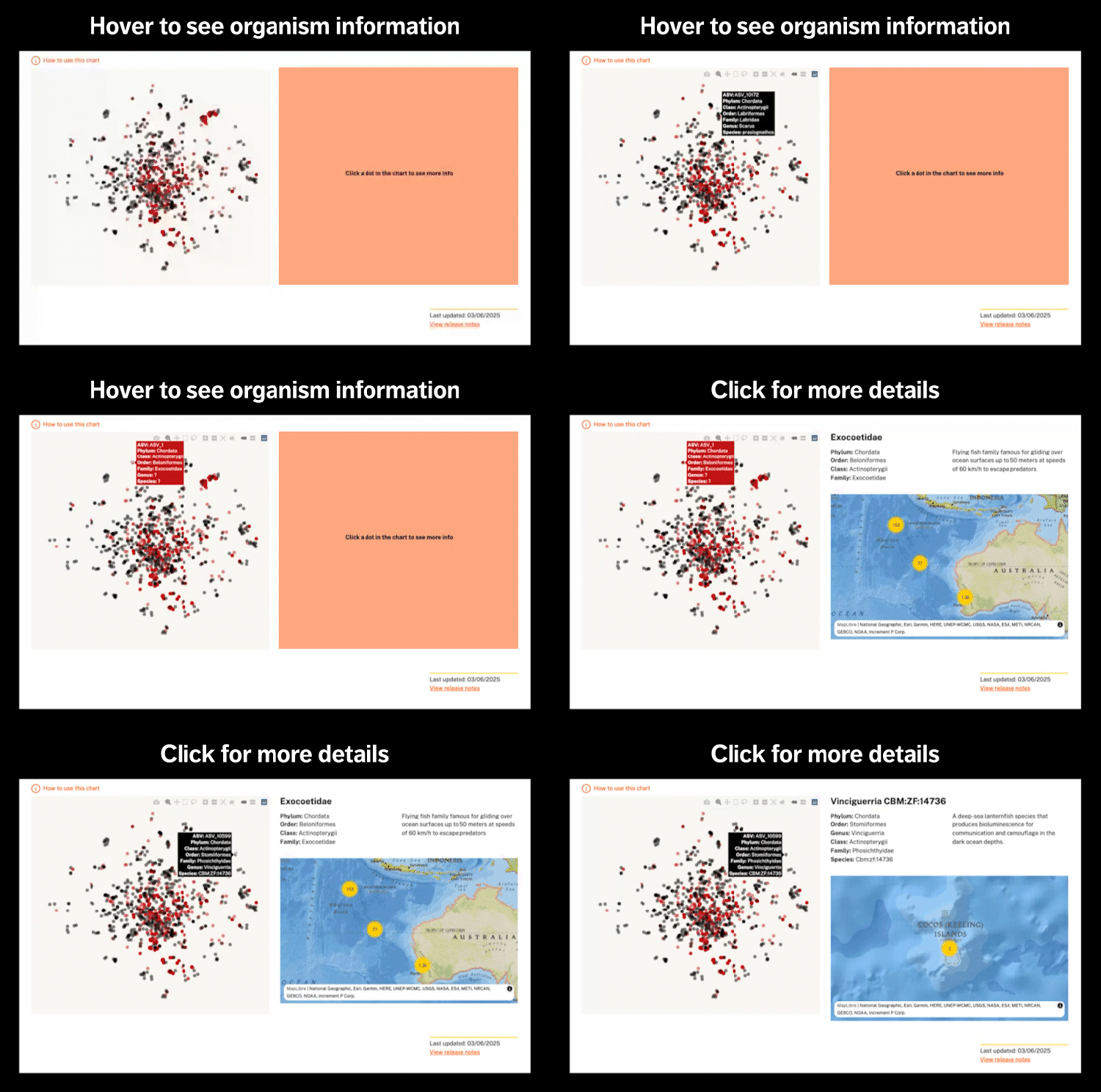
To better understand this hidden diversity, we trained a DNA-based large-language model DNABERT-S using eDNA metabarcoding data. We then used a statistical method called tSNE to group eDNA sequences based on patterns the model has learned, creating a visual map of their relationships.

Explore the visualisation below to see how eDNA sequences cluster together. The accompanying video and interactive tool provide a simplified demonstration of the approach, using a subset of the data for illustration purposes only.

Now it is your turn to have a go!

Click on a dot in the chart to discover the knowns and unknowns of the ocean revealed through eDNA.

Please note that this visualisation uses a simplified subset of the data and is intended for demonstration purposes only.

How to use this chart

Ever wanted to ask the ocean a question? Now you can… sort of. This AI-powered tool lets you explore eDNA data through simple questions and prompts.

Whether you are curious about sharks, exploring the biodiversity of an area close to you, or comparing biodiversity between regions, this tool makes it easier to explore and understand eDNA data.

Using artificial intelligence, this tool can interrogate eDNA data and generate biodiversity insights in real time. Simply type your question and let the model dive into the data for you. This tool is powered by Anthropic's Claude 4.5 Sonnet, a large language model that writes and runs Python code behind the scenes to answer your questions, helping turn complex genomic data into accessible information.

Examples

  • "Have you found any whale sharks in the dataset?"
  • "How many distinct species of fish were found in or around the Recherche Archipelago?"
  • "What deep-sea species are present in this dataset, and where were they detected?"

A few things to keep in mind:

  • Be patient. It might take a few moments to process your question; the tool is searching through billions of lines of eDNA data to find the answer.
  • Don't take the results at face value. AI-generated responses may contain errors and should be independently validated.
  • Try rephrasing your question. You might get a better answer the second time.
  • Be specific.The more detail you provide, the better the results are likely to be.
  • Ask it to explain its reasoning.The model can describe how it arrived at an answer and help you interpret the results

Ask me anything
Response
This question can not be answered by our data and model. Please try again.

Learn more about the project, people, organisations and technologies behind this dashboard.

About the project

Minderoo Foundation and Parks Australia partnered to explore how environmental DNA (eDNA) can support biodiversity monitoring across Australia's vast ocean estate. This dashboard showcases the data-driven outcomes of that collaboration. Using eDNA technologies, the project collected and analysed biodiversity data from across Australian waters, providing insights into species distributions and genetic diversity. It also demonstrated the potential of eDNA as a scalable and cost-effective approach to monitoring biodiversity in Australia's vast and remote marine environments, complementing traditional survey methods. This work was supported by Minderoo Foundation and Parks Australia's Ocean Discovery and Restoration (ODR) Program.

For more information on the outcomes of this project, please see Catalysing the uptake of environmental DNA (eDNA) into marine park management across Australia

Contact

If you have any feedback, suggestions or questions about this dashboard, please contact us at:

oceanomics@minderoo.org

About the Ocean Discovery and Restoration Program

Recognising the importance of strategic partnerships in advancing marine science and conservation, the Australian Government established the Ocean Discovery and Restoration (ODR) Program to support projects that improve the understanding and sustainable management of Australian Marine Parks. Through the ODR Program, Parks Australia co-invested in a range of initiatives designed to enhance knowledge of marine species and habitats while demonstrating how innovative technologies can help address biodiversity monitoring and management challenges.

About Minderoo Foundation

Minderoo Foundation is an Australian philanthropy founded by Dr Andrew Forrest AO and Nicola Forrest AO in 2001, working to forge a fair future. A fair future means every person has the opportunity to thrive in a healthy environment – now and for generations to come.

We focus on three areas: uplifting communities, supporting gender equality and safeguarding our natural ecosystems. Alongside these focus areas, we respond to existential threats and urgent challenges in an agile and targeted way through a series of impact missions.

Our work is grounded in evidence and driven by strong partnerships. By standing alongside those already making an impact, we help solutions go further to deliver lasting change.

Acknowledgements

Acknowledgement of Country

We respectfully acknowledge the Traditional Custodians of the Sea Country across all regions studied as part of this project. We recognise their continued connection and care to land, water and community. We pay our respects to Elders past, present, and emerging.

Community and Partners

This work was made possible through the support of many community partners and collaborators. We gratefully acknowledge Australia’s Department of Climate Change, Energy, the Environment and Water (DCCEEW) and Parks Australia, the Shires of Christmas Island and Cocos (Keeling) Islands, Cocos Marine Care, Sea Country Solutions, the Yamatji Sea Rangers, and the Esperance Tjaltjraak Native Title Aboriginal Corporation.

We also thank the captains, crew and field teams who supported sample collection across Australian waters.

Research partners
Minderoo OceanOmics Centre at UWA

We acknowledge the team at the Minderoo OceanOmics Centre at UWA for their work and expertise in processing and analysing the eDNA samples collected through this project and featured in this dashboard.

Deep-Sea Research Centre at UWA

We thank the Deep-Sea Research Centre at UWA for supporting eDNA sample collection from remote abyssal and hadal marine environments as part of this project.

CSIRO National Biodiversity DNA Library (NBDL)

We thank CSIRO’s NBDL and its partners for providing reference data that supported the DNA-based biodiversity identification across this project.

Technology partners

The eDNA Workflow

Environmental DNA (eDNA) can be collected and analysed in different ways, depending on the environment and research goals. For this project, seawater samples were collected using Niskin bottles or an in-situ filtration system, the Ocean Diagnostics Ascension device. Niskin bottles were deployed either manually, or mounted on CTD rosettes or benthic landers (for deep ocean sampling).

Following collection, seawater was passed through fine mesh filter paper (typically 0.45–0.8 µm), from which eDNA was extracted. The extracted eDNA was analysed by metabarcoding, a method that amplifies and sequences short genetic markers from complex DNA mixtures to detect and identify marine organisms across a broad range of taxonomic groups.

By targeting multiple mitochondrial gene regions (such as 12S and 16S rRNA genes), we can achieve a strong taxonomic resolution across marine vertebrates, the target group of this project. The resulting DNA sequences were processed using the OceanOmics custom bioinformatic amplicon pipeline which includes demultiplexing, quality control steps and denoising via DADA2. The pipeline generates DNA barcodes that are compared against reference databases to assign taxonomic identities, with species-level identification applied where confidence is sufficient. When a species-level assignment cannot be made with confidence, the DNA barcode is instead assigned to the most appropriate genus, family or higher taxonomic level.

This approach allows us to characterise marine vertebrate biodiversity from trace genetic material suspended in the water column. The OceanOmics pipeline is openly available on GitHub.

For information on tree-of-life data, please visit Wilderlab's website.

Primers used
Primer NamePrimerTarget geneSequence (5'-3')Length (bp)Amplicon length (bp)GC content (%)Annealing temp °CReference
16SFish16SF/D16S rRNAGACCCTATGGAGCTTTAGAC20178-2284554Berry et al. 2017
16S2R/D16S rRNACGCTGTTATCCCTADRGTAACT22178-2285054Deagle et al. 2007
MiFish-UMiFish-U-F12S rRNAGTCGGTAAAACTCGTGCCAGC21163–18557.160Miya et al. 2015
MiFish-U-R12S rRNACATAGTGGGGTATCTAATCCCAGTTTG27163–18544.460
MiFish-E2MiFish-E2-F12S rRNARGTTGGTAAATCTCGTGCCAGC22163-18552.460Miya M, Sado T, 2019a
MiFish-E2-R12S rRNAGCATAGTGGGGTATCTAATCCTAGTTTG28163-18542.960
MarVer1MarVer1-F12S rRNACGTGCCAGCCACCGCG16197-21281.354-56Valsecchi et al. 2020
MarVer1-R12S rRNAGGGTATCTAATCCYAGTTTG20197-21242.154-56

Frequently asked questions

eDNA offers a non-invasive, cost-effective, and highly sensitive approach for detecting marine biodiversity. It can reveal the presence of rare, cryptic, elusive or hard-to-observe species without needing to catch or directly observe them, making it a powerful complementary tool for biodiversity monitoring, environmental management and conservation.

Yes and no. While there are often correlations between eDNA signal strength and factors like biomass or abundance, standard eDNA approaches (such as broad scale metabarcoding) are not yet reliable for estimating exact numbers. However, some targeted methods, such as species-specific quantitative PCR (qPCR), can provide more precise estimates of abundance or biomass for target species.

eDNA can also help identify patterns and trends over time and across locations. For example, it can be used to detect seasonal changes in species occurrence, compare biodiversity between sites or monitor changes associated with management actions and environmental conditions (e.g. inside and outside a marine park).

eDNA can detect a wide range of organisms, from microbes to large vertebrates, as long as their DNA is present in the environment and matches reference databases. The type of assay used in eDNA analysis will determine which groups of organisms are targeted for detection.

eDNA typically lasts from a few hours to a few days, and sometimes up to a week or more in colder or deeper waters. Because eDNA degrades over time, it is generally considered a snapshot of recent biological activity. This makes it a valuable tool for understanding which organisms have been present in an area recently and for monitoring changes in biodiversity across time and space.

Release notes

28/08/2026

V 2.0.0 – Marine Parks Version 2 update
  • Updated underlying data connections to draw from OceanOmics and Wilderlab eDNA sample database
  • Expanded available sample and taxonomic data
  • Reworked the 'Explore by park' page to improve user experience and data visualization. This is now the 'Explore by area' page
  • Added new search options to 'Explore by area' page to allow users to search by park network, state/territory, Australian marine regions, and high seas samples
  • Reworked the 'Explore by species' page to improve user experience and data visualization
  • Updated branding and theme

26/06/2026

V 1.2.0 – 'Chat with the data' AI tool update
  • Refactored the 'Chat with the data' AI tool to improve performance and reliability
  • Updated system prompt and agent context for improved working & answer consistency
  • Introduced session limits for the AI tool to prevent excessive usage and ensure fair access for all users

17/02/2026

V 1.1.1 – claude model update
  • Updated from Claude 3.7 Sonnet to Claude 4.5 Sonnet in the 'Chat with the data' AI integration
  • For more information, see: Claude model deprecations

19/12/2025

V 1.1.0 – site reports
  • Updated 'explore by park' page to require a marine park to be selected before displaying eDNA sample data
  • Added links between eDNA samples and associated site reports, where available
  • Site reports are generated externally and hosted on S3 for public access

23/07/2025

V 1.0.0 – initial release
  • Initial dashboard
  • Using first version of OceanOmics internal DNA database

Not found